The heart is the organ that delivers blood in our body. It’s a part of a group of organs named “noble organs”, which means we can’t live without it. The heart helps to keep our vital signals such as blood pressure, heart frequency, pulse, etc.
The heart acts like a pump, by sending oxygenated blood to other organs (including itself) to ensure their correct functioning. Because of its importance, the heart is susceptible to many dysfunctions and diseases. So, it’s a necessity to keep perfect heart health.
About heart anatomy
The heart is an organ located in the rib cage, precisely forward in the mediastinum (which is the space between the two lungs). It rests on the diaphragm, which is the main respiratory muscle and separates the rib cage and the abdomen.
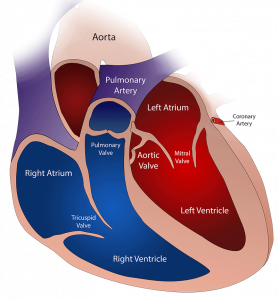
The heart is a pump made of four cavities: two ventricles and two atria. On the left and on the right, every atrium communicates with a ventricle through a valve system which controls the blood passage. There is the mitral valve on the left side and the tricuspid valve on the right side. Some cardiovascular diseases are the result of the dysfunction of those valves.
The heart consists of three layers. From the outside to the inside, we have:
- The pericardium: a fibrous membrane which envelops the heart.
- The myocardium: it’s the heart muscle which ensures his contraction.
- The endocardium: it’s a layer of cells inside the heart. It prevents the blood clotting at its contact with the endocardium and indirectly acts on the heart contraction.
The normal heart functioning
The heart delivers blood in the organism. The oxygen-depleted blood, coming from the organs, flows through the veins to reach the right atrium through large veins called vena cava (superior and inferior vena cava).
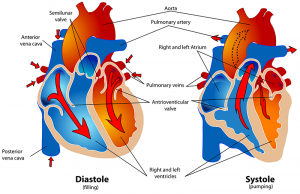
Once the blood reaches the right atrium, the tricuspid valve opens and the right ventricle is filled with blood. When it’s fully filled, the tricuspid valve closes and the right ventricle contracts. The pulmonary valve opens to send blood to the lungs through the pulmonary artery to become enriched with oxygen.
The oxygen-rich blood coming from the lungs reaches the left atrium through the pulmonary veins. The left atrium fills and the mitral valve opens to fill the left ventricle with oxygenated blood. Once it’s done, the mitral valve closes and the left ventricle contracts. The aortic valve opens to send oxygen-rich blood through the aorta (a large blood vessel) which will deliver the blood to the organism.
The contraction of both right and left ventricle is simultaneous. Any blood vessel that reaches the heart is called an artery, and any blood vessel that leaves the heart is called vein.
Heart auscultation
It’s the main step of the heart examination. It’s about listening to the heart sounds with a stethoscope. The patient should be laid and bare-chested. There are some areas on the thorax where the heart sounds are better heard:
- The aortic area, between the 2nd and 3rd rib on the right side (2nd intercostal space).
- The pulmonary area, between the 2nd and the 3rd rib on the left side (2nd intercostal space).
- The mitral area, between the 5th and the 6th rib on the left side (5th intercostal space); there’s located the apex of the heart.
- The tricuspid area, located at the tip of the sternum (the bone in the middle of the thorax.
The heart sounds heard at the different areas result from the closing of the different valves. Normally, just two sounds are heard:
- The first heart sound S1 results from the simultaneous closing of the mitral and the tricuspid valves when the ventricles contract to push the blood into the vessels.
- The second heart sound S2 results from the simultaneous closing of the aortic and pulmonary valves when the blood leaves the atrium to fill the ventricle.
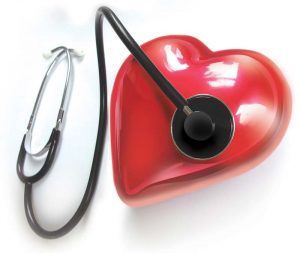
During the cardiovascular examination, the pulse palpation is very important to make sure that the heart is normally beating. The pulse reflects the blood flow propelled into the blood vessels, precisely the arteries. The pulse also allows calculating the heart rate by counting the number of pulses during one minute. Normally, the resting heart rate ranges from 60 to 120 beats per minute.
Electrocardiogram (ECG)
Unlike the cardiac auscultation, which is a physical examination, the electrocardiogram analyzes the electrical activity of the heart. It’s done by using electrodes: six electrodes numbered from V1 to V6 placed on specific areas of the thorax, four others with red, black, green and yellow color index placed on the wrists and ankles. It allows us to analyze the electrical activity of the heart in several angles: front, back, up, down, left or right, etc.
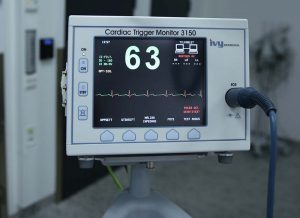
The result is obtained in the form of a graph, divided into several parts named waves. The waves analysis allows detecting early some heart diseases even if they are asymptomatic.
ECG abnormalities: cardiac conduction disorders
Tachycardia
A regular heartbeat with a high heart rate higher than 120 beats per minute. It manifests as tiredness, chest pain, dizziness which can lead to unconsciousness. Tachycardia can be caused by arterial hypertension, infection, stress or high rate of thyroid hormone.
Fibrillation
An irregular heartbeat with a high heart rate. It can occur in the atria; we call it atrial fibrillation. It manifests as palpitations, dizziness, and unusual tiredness. It can lead to a heart attack if the care is not done in time with a defibrillator.
The ventricular fibrillation is more serious because it can lead to a heart attack just in the first minutes following the beginning of the symptoms if the care is not immediate.
Bradycardia
It’s a regular heartbeat with a low heart rate lower than 60 beats per minute. It can be asymptomatic (no clinical signs) or it can manifest as an unusual tiredness, dizziness, imminent heart attack feeling.
ECG abnormalities: cardiac conduction disorders
Normally, for the ventricles to contract, they have to receive an electrical signal from the atria. An abnormality can occur during the transmission of this signal from the atria to the ventricles; it’s called conduction disorder which can be detected with an ECG.
Conduction disorders, usually called blocks, are of two types:
- The atrioventricular block: the abnormality occurs during the transmission of the electrical signal from the ventricles to the atria.
- The bundle branch block: the abnormality occurs during the transmission of the electrical signal inside the ventricles.
Bradycardia is usually the main symptom of conduction disorders.
If an ECG is abnormal, we must look for an associated disease.
Cardiovascular Diseases
Cardiovascular diseases touch the heart and the blood vessels of the body. According to a WHO report from 2016, they are the first cause of mortality in the world.
The risk factors
The main risk factors are:
- A poor diet: excess salt in diet (often in potato chips, snacks) can cause hypertension.
Also, a high-fat diet, mostly animal fat.
Foods like refined sugar (in white bread, rice or pasta), treats, other sugar-based products, processed fat of industrial food, red meat, fried foods… all these foods aren’t good for heart health. They have to be cut back or even totally removed from the diet. - Lack of physical activity.
- Alcohol and tobacco.

Those factors will lead to obesity, accumulation of bad cholesterol in the body mostly in the blood vessels, diabetes and arterial hypertension; all these elements will weaken the heart and the blood vessels.
Some cardiovascular diseases can be congenital which means people are born with the disease.
What are the more frequent cardiovascular diseases?
Cardiovascular diseases touch the heart and also the blood vessels of the body, whether it is in the brain, the upper and lower limbs.
With the risk factors (obesity, diabetes, hypertension), cholesterol tends to accumulate in the blood vessels wall. The cholesterol will form what we call the atheromatous plaque (it is atherosclerosis).
The atheroma plaque can clog or weaken the blood vessels. It can also break and send some “piece” called embolus in the blood flow. Those emboli can clog other blood vessels of the body and cause different cardiovascular diseases according to the localization.
Coronary diseases
It’s the most frequent cardiovascular disease. It concerns the heart blood vessels called coronary vessels. If the coronary vessels are clogged, it’d barely provide blood to feed the heart muscle.
It manifests itself as angina pectoris or simply angina. People who have angina, typically they have an acute chest pain which projects to the jaw, the shoulders and the arms. It manifests during a physical effort, during stress or at rest. The pain can come with vomiting, nausea or palpitations.
The pain intensity changes from a simple discomfort to an unbearable pain which can be calmed down more or less quickly by the nitroglycerine, which is a drug that reduces the work of the heart by enabling the dilatation of the coronary vessels.
The angina care needs to be fast, otherwise, it can lead to a myocardial infarction or heart attack. It’s an irreversible death of the heart cells which can lead in the long run to a heart failure which means the heart cannot pump the blood efficiently.
To confirm the diagnosis of angina, it’s important to do an ECG to estimate the damages on the heart and the different parts affected. The troponin test can also help to estimate the damages on the heart. Indeed, when the heart cells die, they release troponins (proteins present in the heart cells).
Stroke
It is a brain failure due to the obstruction or a rupture of one of the brain blood vessels. This failure can damage any part of the brain, whose severity depends on which part is affected. In fact, each part of the brain controls specific functions of the body.
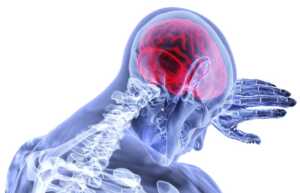
The symptoms are acute, sudden, without warning signs and they’re different depending on which part of the brain is touched. A stroke can manifest itself by feeling unsteady, numbness of a limb, face paralysis, headache, a sudden and transitory sight loss (this can concern just one eye or both), difficulty to talk or write, etc.
A stroke is an emergency and has to be managed immediately in the first minutes following the beginning of the symptoms, at the risk of some health effects whose severity depends on the affected cerebral part and the period between the apparition of the symptoms and the care.
The health effects of a stroke are:
- The irreversible paralysis of one half of the body.
- Memory impairment, difficulties of concentration.
- Speech or writing impairment.
- Disability to recognize the shape of objects.
- Loss of sensations (to cold or to heat) etc.
The doctor has to look for some risk factors such as hypertension, obesity, diabetes. He also looks for the cause of the stroke by doing urgently a brain scanner that must show which part of the brain is damaged.
Cardiomyopathy
It’s a group of diseases that affect the heart muscle and cause the failure of his functioning. The risk factors can be inflammation, infection, toxic elements (alcohol, cocaine), drugs (e.g. drugs used in chemotherapy). They can also be hereditary or related to metabolic diseases such as diabetes.
Cardiomyopathies are rare comparing to coronary diseases and strokes.
The care of cardiovascular diseases
It’s about all the measures taken to treat people affected by cardiovascular diseases. Those measures can be drugs, treatment by surgery and prevention of risk factors.
Which drugs are used in the treatment of cardiovascular diseases?
- Anticoagulants: they prevent the blood clots particularly among people who have an irregular heart rate or people who have an artificial heart valve.
- Thrombolytic drugs (clot-busting drugs): they destroy blood clots already formed in the vessels, which do not allow blood to flow in the organs.
- Other drugs such as beta blockers, diuretics and digoxin (improves the heart rate) can be used according to the disease.
Those drugs are taken only by medical prescription. The prescription and drug doses have to be respected even if you are feeling better. Some drugs like thrombolytic are used only in a hospital setting.
In some cases, cardiovascular disease can be treated by surgery to restore the normal blood flow in the vessels.
Risk factors (obesity, hypertension, diabetes) need to be considered and treated as well to prevent the progression of the disease, limit the damages and improve the living conditions.
The most effective measure is to adopt and maintain a healthy lifestyle:
- Avoid physical inactivity.
- Stop smoking.
- Avoid diet too rich in salt.
- Have a healthy and balanced diet.
Some heart-healthy foods

- Foods high in antioxidants: fruits and vegetables like carrots, eggplant, garlic mango, onions, grape, blueberry, pomegranate.
- Foods high in good fat: olive oil, avocados, oilseed (almond, nuts, peanuts, etc.).
- Foods high in omega-3 of animal sources (salmon, mackerel, sardine, tuna fish) or vegetable sources (flax oil, nut oil, rapeseed oil, etc.).
- Vegetable proteins (lens, beans, chickpea). They are also rich in potassium which prevents hypertension.
The treatment of cardiovascular diseases using only drugs is not enough. A healthy lifestyle is necessary to improve your health. The prevention of risk factors is the best way to prevent cardiovascular diseases.