
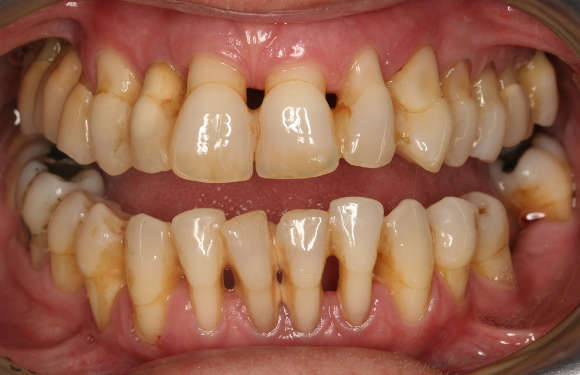
What is periodontitis?
The periodontium is the term attributed to the supporting (alveolar bone, root cementum, and periodontal ligament) and investing (gingiva) structures of the teeth.
Inflammation and destruction of the periodontium are termed as periodontitis which is characterized by tooth mobility, gingival recession, and bone resorption.
It constitutes one end of a spectrum composed of gingivitis. If gingivitis is left untreated, the disease can progress to periodontitis as a result of the proliferation of periodontopathic bacteria due to inadequate immune response or lack of competition with commensal bacteria.
What are the causes of periodontitis?
Causes of periodontitis include:
Plaque biofilm
This constitutes the primary cause of all forms of periodontitis. It is an adherent mass of a group of bacterial micro-colonies that live in symbiosis. The colonies communicate with each other, they develop in a structured way and are functionally and spatially organized.
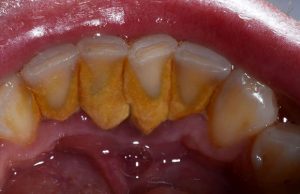
Plaque and Tartar (Calculus) may cause Periodontitis
Bacteria in plaque biofilm cause damage to the periodontium by directly secreting harmful bacterial products. These include proteases, bone resorption factors, leukotoxins and cytotoxic metabolites. Furthermore, they indirectly induce host inflammatory response (neutrophils, macrophages, …) which do not only cause damage to the involved bacteria but also to the adjacent periodontal structures.
Systemic diseases
Systemic diseases can influence the occurrence of periodontitis and they are broadly classified into three categories according to the International Workshop for the classification of periodontal disease in 1999. Below are the categories and their subdivisions.
1. Hematological disorders
- Acquired neutropenia.
- Leukemias.
- Other.
2. Genetic disorders
- Familial and cyclic neutropenia.
- Down syndrome.
- Leukocyte adhesion deficiency syndrome.
- Papillon-Lefèvre syndrome.
- Chediak Higashi syndrome.
- Glycogen storage disease.
- Infantile genetic agranulocytosis.
- Cohen syndrome.
- Ehlers-Danlos syndrome (type IV and V).
- Hypophosphatasia.
3. Not otherwise specified
This category includes endocrine diseases like diabetes mellitus, persistent endodontic lesions that can cause periodontitis, smoking, stress, obesity and any disease state that can cause a depression in the immune system.
Pregnancy
Pregnancy can also cause periodontitis.
What are the different types of periodontitis and their respective signs and symptoms?
There are three types of periodontitis:
Chronic periodontitis
This type of periodontitis is known to affect people with their age greater than thirty years old and is characterized by heavy deposition of plaque biofilm, gingival inflammation and bleeding, gingival recession, tooth mobility, tooth migration, discomfort, halitosis, and horizontal bone loss on the radiograph.
At earlier stages, usually there is very little in the way of obvious signs or symptoms therefore probing is essential. It can be regarded as a progression of the combination of infection and inflammation of gingivitis into the deep tissues of the periodontal membrane. Microorganisms (P.gingivalis, T.forsythia, P.intermedia, etc) have a low level of virulence. Therefore, a lot of them are required to cause damage to the periodontium.
Depending on the clinical attachment level (distance between the base of the pocket and cervical portion of the tooth), chronic periodontitis can be said to be:
- Mild if the clinical attachment level is within the range of 1-2 mm.
- Moderate if the clinical attachment level is within the range of 3-4 mm.
- Severe if the clinical attachment level is greater than 5mm.
Also, based on the number of teeth affected, chronic periodontitis is said to be:
- Localized if less than 30% of sites are affected.
- Generalized if more than 30% of sites are affected.
Aggressive periodontitis
The pattern of progression of this type of periodontitis is described by its name. It is characterized by the rapid destruction of the periodontium and requires minimal plaque deposition since the microorganism (Aggregatibacter Actinomycetemcomitans) involved has a high virulence. It usually affects people aged less than thirty years and has a hereditary pattern. It exhibits a vertical bone loss pattern on the radiograph.
Clinical signs are the same as chronic periodontitis. The disease progresses so fast that the body’s immune system runs out of time to produce mature immune cells that will fight the periodontal infection.
It can also be:
- Localized if there is an attachment for at least two permanent teeth, one of which is the first molar and involving no more than two teeth other than first molar and incisors. When localized, the antibody serum is robust.
- Generalized if there is attachment loss affecting at least three permanent teeth other than first molar and incisors. The antibody serum, in this case, is poor.
Necrotizing Ulcerative Periodontitis (NUP)
This type of periodontitis is a progression of the untreated necrotizing ulcerative gingivitis which is characterized by punched out gingival ulcers, halitosis, bone loss, and tooth mobility.
If untreated too, it can progress to necrotizing stomatitis or noma which can disfigure affected individuals. The main microorganism involved is spirochetes.
What is the treatment of periodontitis and how to prevent it?
The best prevention method against periodontitis is regular scaling and polishing. Therefore, a regular visit to the dentist for a check-up is necessary. Maintaining good oral hygiene also plays an important role in preventing the occurrence of the disease. Hence, tooth brushing twice a day (morning and evening before sleeping) is strongly recommended.
Treatment of periodontitis is done in a certain number of phases depending on the presence of periodontal emergencies and the extent of involvement and destruction of the periodontium.
Phases of treatment include:
The preliminary phase
The preliminary phase consists of the elimination of periodontal emergencies such as abscesses.
The initial phase
The initial (cause-related) phase, where the aim is to control plaque and address modifiable risk factors (e.g. smoking cessation counseling, liaise with a general medical practitioner if poorly controlled diabetes). Periodontitis is an infection due to the presence of plaque biofilm, therefore, disruption of the plaque biofilm and control of plaque is the key to success.
More complex treatments will always fail in the absence of effective plaque control. Includes a recording of baseline indices, oral hygiene instructions, scaling and root surface debridement, elimination of plaque retention factors.
The response is monitored 8–12 weeks after treatment and the further plan made. If successful can move to a supportive phase. If residual disease then move to the corrective phase.
The corrective phase
The corrective phase is designed principally to restore function and, where relevant, aesthetics. Corrective techniques include further non-surgical therapy, periodontal access surgery, regenerative surgery, mucogingival surgery, resective surgery, e.g. gingivectomy, selected use of local and systemic antibiotics where indicated, treatment of furcation lesions, restorative work, endodontics, and occlusal adjustment.
The aims of this phase are:
- To eliminate pathological periodontal pockets, or to create a tight epithelial attachment where the pocket once existed.
- To arrest loss of, and in some cases improve, the alveolar bone support.
- To create an oral environment that is relatively simple for the patient to keep plaque-free.
The supportive phase
The supportive phase aims to reinforce patient motivation so that their oral hygiene is adequate to prevent the recurrence of the disease. This is done through continuous scaling and polishing (at least twice a year) and strict respect of oral hygiene instructions given by the dentist.

